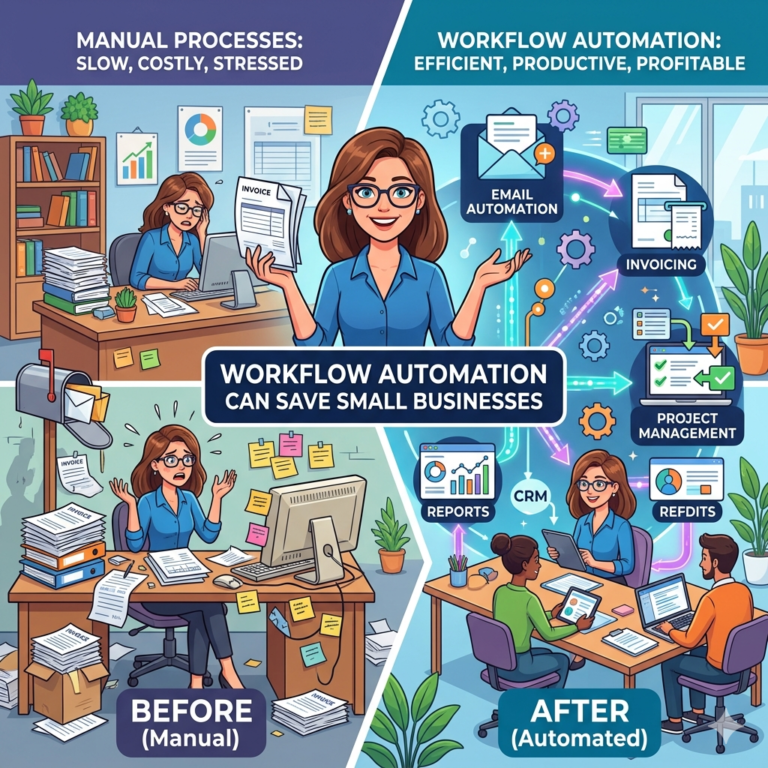

How AI Automation Is Transforming Businesses in 2026
In 2026, businesses are no longer competing based on who works harder—but on who works smarter.
Artificial Intelligence (AI) and automation are quickly becoming the backbone of modern companies. From startups to established businesses, those who adopt smart systems are scaling faster, reducing costs, and outperforming competitors.
The question is no longer if you should use AI, but how fast you can implement it.
What Is AI Automation in Business?
AI automation combines artificial intelligence with software systems to handle repetitive tasks, analyze data, and improve decision-making.
Instead of relying on manual processes, businesses can now automate:
- Customer interactions
- Internal workflows
- Data analysis
- Marketing campaigns
- Operations and reporting
This shift allows companies to operate more efficiently and focus on growth instead of daily bottlenecks.
Why Businesses Are Investing in Automation
1. Reduce Operational Costs
Manual processes cost time and money. Automation eliminates repetitive tasks and reduces the need for large teams handling routine work.
2. Increase Efficiency
Automated systems work 24/7 without errors, delays, or downtime. This means faster execution and better results.
3. Better Decision Making
AI tools analyze large amounts of data and provide insights that help businesses make smarter decisions.
4. Scalability Without Chaos
As your business grows, manual systems break. Automation allows you to scale without increasing complexity.
The Problem: Most Businesses Implement AI the Wrong Way
Here’s the reality: Many companies jump into AI tools without a clear strategy. They use disconnected apps, patch systems together, and end up with more complexity instead of less.
The result?
- Inefficiency
- Poor integration
- Wasted investment
AI alone is not the solution. Systems are.
The Smart Approach: Build Systems, Not Just Tools
Successful businesses don’t just use AI—they build integrated systems.
This includes:
- Custom software tailored to your operations
- Seamless integrations between tools
- Automated workflows aligned with business goals
Instead of adding more tools, the goal is to create a centralized system that works together.
Examples of AI Automation in Action
Here are real-world use cases:
- Automating customer onboarding processes
- Creating smart dashboards with real-time data
- Automating lead generation and follow-ups
- Streamlining internal operations and approvals
- Reducing manual data entry with integrations
These improvements don’t just save time—they directly impact revenue.
How to Start Implementing AI in Your Business
You don’t need to automate everything at once.
Start with this:
- Identify repetitive tasks
- Analyze inefficiencies
- Define your business goals
- Build or implement a system (not just tools)
- Scale gradually
The key is strategy first, technology second.
If you’re looking to implement AI and automation the right way, Merhouse Consulting helps businesses design and build scalable systems tailored to their needs.
👉 Let’s build smarter systems for your business.