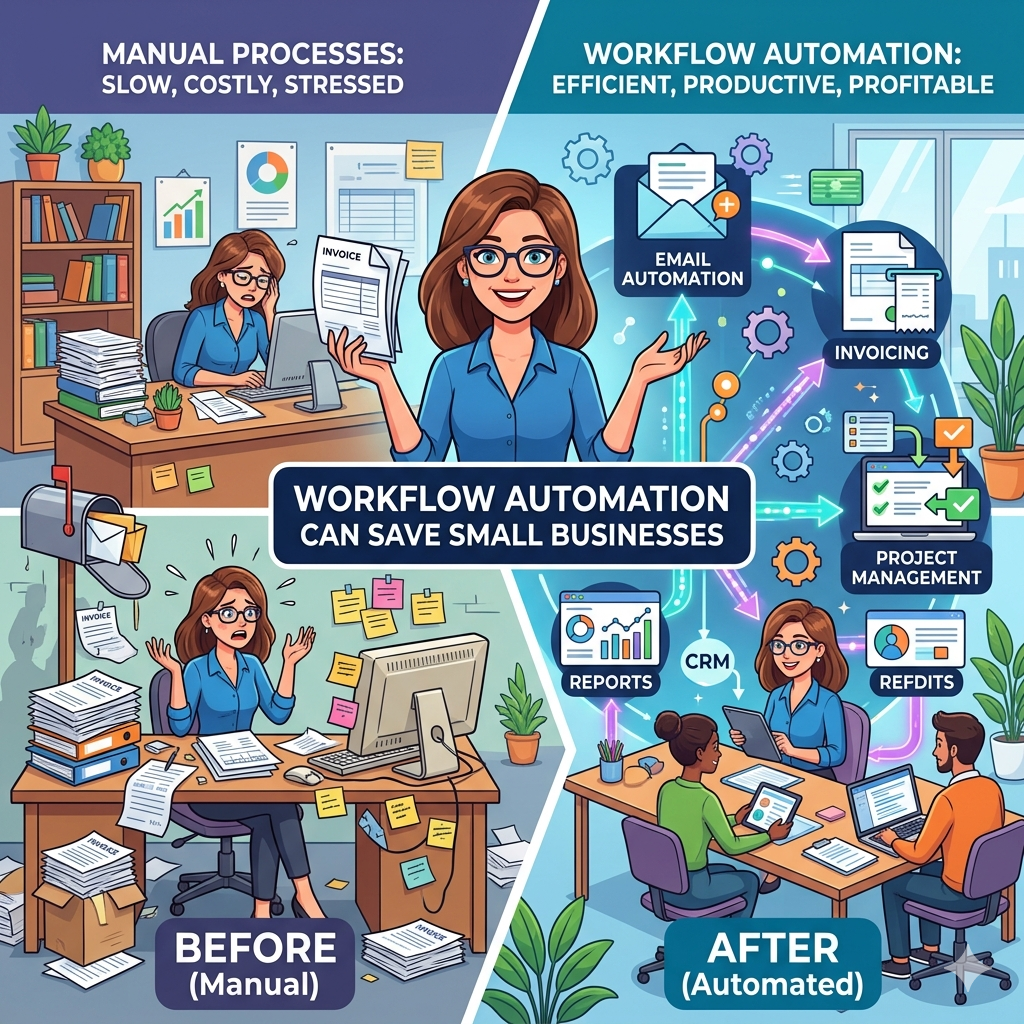
Running a small business today involves much more than simply selling products or services. Business owners must manage customer communication, invoices, appointments, social media, follow-ups, marketing campaigns, and daily operations — often with limited staff and resources.
As businesses grow, repetitive manual tasks begin consuming valuable time that could otherwise be invested in sales, customer service, or business development.
This is where workflow automation becomes one of the most valuable investments a business can make.
In 2026, automation is no longer reserved for large corporations. Modern digital tools now allow small and medium-sized businesses to automate repetitive processes, improve operational efficiency, reduce human error, and create better customer experiences without hiring large teams.
At Merhouse Consulting, we help businesses implement smart digital workflows that simplify operations and support long-term growth.
What Is Workflow Automation?
Workflow automation is the process of using software and digital tools to perform repetitive business tasks automatically.
Instead of manually completing the same actions every day, automation systems can trigger tasks based on specific events or conditions.
Examples include:
- Automatically sending appointment confirmations
- Generating invoices after a purchase
- Sending follow-up emails to leads
- Posting content to social media platforms
- Syncing customer information between systems
- Sending reminders for unpaid invoices
- Automating onboarding processes
- Managing internal notifications and approvals
Automation reduces manual work and allows businesses to operate more efficiently.
Why Small Businesses Need Automation
Many small business owners believe automation is too expensive or complicated. In reality, modern automation tools are more accessible than ever.
Without automation, businesses often experience:
- Lost leads due to delayed responses
- Repetitive administrative work
- Inconsistent customer communication
- Human errors in data entry
- Missed appointments or deadlines
- Difficulty scaling operations
- Employee burnout from repetitive tasks
Workflow automation solves these challenges by creating systems that work consistently in the background.
Common Business Processes That Can Be Automated
1. Customer Communication
Businesses can automate:
- Welcome emails
- Appointment confirmations
- Customer reminders
- Feedback requests
- Follow-up sequences
- Lead nurturing campaigns
Automated communication improves response times and customer satisfaction.
2. Appointment Booking Systems
Service-based businesses often spend hours coordinating appointments.
Automation tools can:
- Allow online booking
- Send confirmations automatically
- Reduce no-shows with reminders
- Sync calendars in real time
- Process deposits or payments
Industries that benefit include:
- Medical clinics
- Beauty salons
- Consultants
- Fitness trainers
- Home services
- Legal professionals
3. Social Media Scheduling
Consistent content posting is important for brand visibility, but manual posting consumes time.
Automation platforms can schedule content across:
- X (Twitter)
- TikTok
This helps businesses maintain consistent online activity while reducing manual effort.
4. Lead Management and CRM Automation
Businesses lose potential customers when leads are not properly tracked.
CRM automation allows businesses to:
- Capture leads automatically
- Organize customer data
- Assign follow-up tasks
- Send automated email sequences
- Track sales opportunities
A structured lead management system can significantly improve conversion rates.
5. Invoice and Payment Automation
Financial workflows can also be automated.
Businesses can:
- Generate invoices automatically
- Send payment reminders
- Process recurring billing
- Track payment status
- Reduce administrative overhead
Automation improves cash flow and reduces late payments.
Benefits of Workflow Automation
Increased Productivity
Automation reduces repetitive manual work, allowing employees to focus on higher-value tasks.
Improved Customer Experience
Faster communication and more consistent service improve customer satisfaction.
Reduced Human Error
Automated systems minimize mistakes caused by manual data entry or forgotten tasks.
Better Scalability
Businesses can handle larger workloads without proportionally increasing staff.
Cost Savings
Automation reduces operational inefficiencies and lowers administrative costs over time.
Faster Response Times
Customers increasingly expect quick communication. Automation allows businesses to respond instantly.
Popular Automation Tools for Small Businesses
Depending on business needs, companies may use tools such as:
- Zapier
- Make (formerly Integromat)
- HubSpot
- Mailchimp
- Calendly
- Amelia Booking
- Google Workspace Automations
- CRM systems
- WordPress automation plugins
The best solution depends on the company’s size, goals, and existing systems.
How Automation Works With WordPress Websites
WordPress remains one of the most powerful platforms for business websites.
With the right integrations, WordPress websites can automate:
- Contact forms
- Lead collection
- Booking systems
- Email marketing
- Membership systems
- E-commerce workflows
- Customer notifications
- Analytics tracking
This creates a centralized digital ecosystem that improves efficiency and customer experience.
Automation Does Not Replace Human Interaction
One common misconception is that automation removes the personal side of business.
In reality, automation handles repetitive administrative tasks so business owners and teams can focus more on:
- Customer relationships
- Strategy
- Sales
- Creativity
- Business growth
The goal is not replacing people — it is improving operational efficiency.
Signs Your Business Is Ready for Automation
Your business may benefit from automation if:
- You repeat the same tasks every day
- Customer responses are delayed
- You manually transfer data between systems
- Your team spends too much time on administration
- You struggle to keep up with leads
- Your scheduling process is inefficient
- You want to scale operations without hiring aggressively
If several of these apply to your business, automation can provide immediate operational improvements.
The Future of Business Automation
Automation technologies continue evolving rapidly.
Artificial intelligence, predictive analytics, smart customer support systems, and integrated digital ecosystems are becoming increasingly accessible to small businesses.
Companies that adopt automation early gain advantages such as:
- Faster growth
- Better customer retention
- Lower operational costs
- Stronger competitive positioning
- More scalable operations
Businesses that delay digital transformation risk falling behind competitors that operate more efficiently.
Final Thoughts
Workflow automation is no longer optional for businesses that want to remain competitive in today’s digital economy.
By automating repetitive tasks, improving communication, and streamlining operations, businesses can save time, reduce costs, and focus on growth.
The right automation strategy depends on each business’s unique goals, workflows, and customer experience needs.
At Merhouse Consulting, we help businesses identify opportunities for automation and implement practical digital solutions that improve efficiency and scalability.
Whether you need automated booking systems, WordPress integrations, CRM workflows, or custom business automation solutions, investing in smarter systems can transform how your business operates.
Ready to Automate Your Business Processes?
Merhouse Consulting helps businesses implement modern digital workflows, automation systems, and scalable technology solutions.
Contact us today to learn how automation can simplify your operations and support your business growth.